
Project Overview
Understanding the Search Experience
Airbnb makes searching for accommodation appear simple, but users often need to make several decisions at once — from destination and price to amenities, cancellation options and the type of property.
For this project, I conducted a moderated usability study to understand how users interact with Airbnb’s desktop search and filtering experience when completing a realistic accommodation task.
MY ROLE
UX Researcher / Moderator
METHOD
Remote Moderated Usability Testing
PLATFORM
Desktop Web
TOOLS
Visily · Microsoft Teams · Canva · Google Drive · TurboScribe
The goal was to observe what users actually do — not simply what they say they would do.
Research Goal
What Happens When Users
Search With Real Constraints?
The study focused on how users navigate Airbnb when searching with specific requirements rather than simply browsing.
I wanted to understand where the experience felt intuitive, where users hesitated, and whether the available search and filtering tools gave them enough confidence to make a decision.
01
SEARCH & FILTERS
How easily can users begin a search and find the filters they need?
02
PRICE & INFORMATION
Do users understand pricing and find the information needed to compare listings?
03
CONFIDENCE
Can users complete the task confidently — not simply successfully?
Success was evaluated through task completion, efficiency, errors and user confidence.
STUDY SETUP
Testing a Realistic Booking Scenario
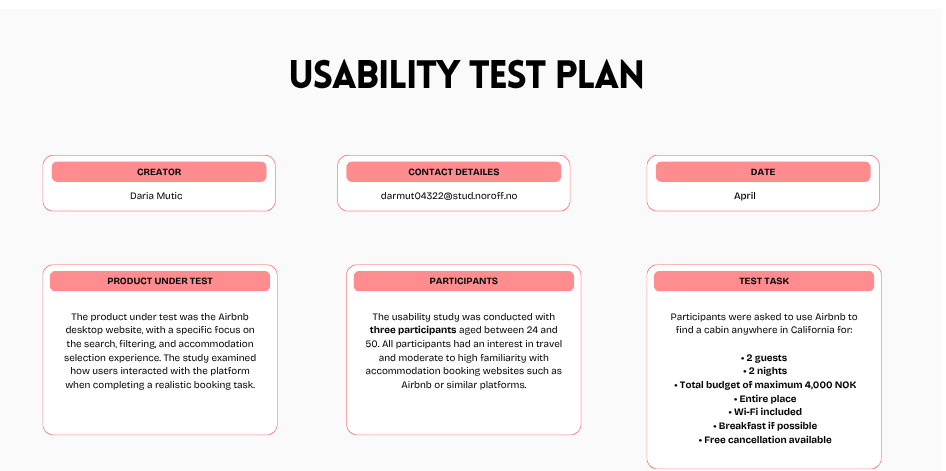
I created a realistic accommodation task with specific requirements, allowing me to observe how participants searched, filtered and compared listings while thinking aloud.
THE TASK
THE SCENARIO
Find a cabin anywhere in California for a short trip with a friend, while staying within a total budget of 4,000 NOK.
2 GUESTS
Travelling with a friend
2 NIGHTS
Short stay
4,000 NOK
Total budget
ENTIRE PLACE
Private accommodation
WI-FI + BREAKFAST
Breakfast if available
FREE CANCELLATION
Required
The combination of specific requirements created a realistic task for observing how participants searched, filtered and compared available listings.
MODERATED TESTING
Observing Behaviour,
Not Just Answers
The purpose of the moderated sessions was not simply to see whether participants could complete the task, but to understand how they approached it.
During each session, I observed where participants looked first, which filters they expected to find, what information they used when comparing properties, and where they paused or questioned what they were seeing. Participants were encouraged to think aloud so I could understand the reasoning behind their actions rather than relying only on the final outcome.
Keeping the same structure across the sessions made it easier to compare behaviours and identify recurring patterns. I avoided directing participants toward specific features or solutions, using follow-up questions instead to understand moments of hesitation, uncertainty or confidence.
01 — INTRODUCE
I introduced the purpose of the session, explained the think-aloud approach and created a comfortable environment where participants understood that the interface—not their ability—was being evaluated.
02 — THINK ALOUD
Participants were encouraged to verbalise what they were looking for, what they expected to happen and why they made particular choices.
03 — OBSERVE THE TASK
While participants searched, filtered and compared listings, I focused on behaviour: pauses, repeated actions, questions, changes of direction and moments where additional checking was needed.
04 — FOLLOW UP
After the task, I asked about moments of uncertainty, expectations and overall confidence to better understand what I had observed during the session.
Testing the Study Before Testing Participants
Before conducting the sessions, I ran a pilot test to evaluate the setup, instructions, task structure and timing.
This helped me identify terminology that could be interpreted differently and areas where the instructions could be simplified. Making these adjustments before the actual sessions helped reduce the risk that confusion caused by the test itself would influence participant behaviour.
The aim was not to guide participants toward success, but to understand what happened when they had to find their own way.
Analysis
Turning Observations Into Patterns
After completing the moderated sessions, I reviewed the observations and participant feedback to look for behaviours that appeared repeatedly across the sessions.
Rather than treating every comment or hesitation as an individual issue, I grouped related observations using affinity mapping. This helped me identify recurring patterns across areas such as search behaviour, filters, pricing, navigation and decision-making.

Grouping observations helped reveal recurring themes around search behaviour, pain points, positive feedback, filters and refinement, decision-making, pricing and value, navigation and opportunities for improvement.
FROM INDIVIDUAL EXPERIENCES TO SHARED PATTERNS
Looking at each participant individually helped preserve the context behind their behaviour before comparing experiences across the study.


Comparing these individual experiences made it possible to identify where participants encountered similar uncertainty, relied on similar information or used similar strategies when evaluating listings.
What Began to Emerge
FILTER CLARITY
Some filters required additional checking and were not always interpreted with confidence.
PRICING UNCERTAINTY
Users questioned how pricing was communicated and whether they understood the full cost.
COMPARISON & TRUST
Comparing several listings increased effort, while photos, reviews and cancellation information became important trust signals.
Completing the task did not always mean feeling confident about the result.
KEY FINDINGS
What Success Didn't Tell Me
All participants were able to complete the booking task, but the sessions revealed an important distinction: completion did not always equal confidence.
The metrics showed whether participants satisfied the task criteria. Their behaviour during the sessions showed where uncertainty remained.



Task Completion
Participants were able to reach a suitable result while meeting the core requirements of the scenario. They successfully navigated the search process, applied relevant filters and identified accommodation that matched the task.
At a task level, this suggests that Airbnb’s search experience supported successful completion. However, observing the sessions revealed that reaching a result did not always mean the journey felt equally clear or effortless.
Participants sometimes paused, returned to filters or opened listings to verify information before making a decision. These behaviours became important because they revealed friction that completion metrics alone could easily hide.
The task was completed successfully — but the path to completion varied considerably between participants.
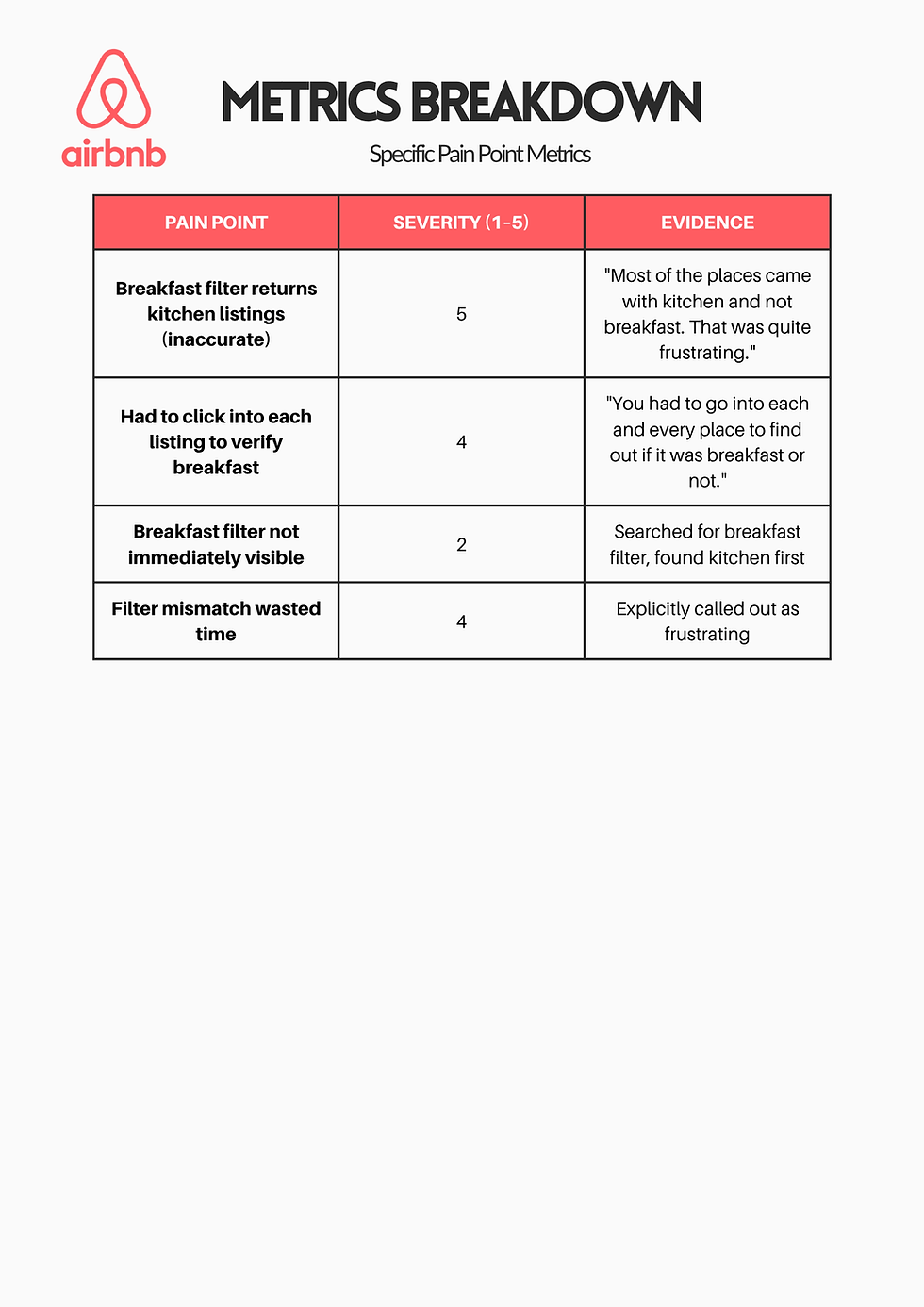
FILTERS REQUIRED DOUBLE-CHECKING
Some requirements—particularly breakfast and free cancellation—were not always immediately clear from the search experience.
Participants sometimes returned to listings or checked additional information before feeling certain that their requirements had been met.
PRICE WASN'T ALWAYS IMMEDIATELY CLEAR
Participants paid close attention to whether the displayed price represented the nightly rate or the total cost of the stay.
This introduced additional checking during comparison and created uncertainty around whether a listing actually remained within budget.
TRUST INFLUENCED DECISION-MAKING
Photos, reviews and cancellation information became important when participants evaluated whether a listing felt suitable and trustworthy.
Meeting the search criteria alone was not always enough to make participants feel confident about their choice.
MORE OPTIONS DIDN'T ALWAYS MAKE CHOOSING EASIER
Opening and comparing several listings increased the amount of information participants needed to keep track of.
More choice therefore did not necessarily make the decision easier and could make comparison feel more demanding.
SUCCESSFUL COMPLETION ≠ COMPLETE CONFIDENCE
The strongest finding was not whether users could complete the task, but how certain they felt about the decision they had made.

Recommendations
From Findings to Opportunities
The study showed that the main opportunity was not to redesign Airbnb’s search experience, but to reduce the uncertainty users experienced while moving through it.
Although participants were able to complete the task, they often needed to verify information before feeling confident about a listing. Pricing, filter behaviour and the visibility of important criteria all contributed to this additional checking.
Based on these findings, I would prioritise making the total cost of a stay clearer earlier in the search journey and improving the visibility of filters such as breakfast and free cancellation. Selected requirements should also be reflected more clearly in the results so users can immediately understand whether a listing matches their needs.
Comparison could also be made easier by surfacing more of the information users rely on when making decisions directly within search results. This could reduce the need to repeatedly open listings, return to filters and remember details across several different options.
Rather than adding more functionality, the goal would be to make the existing experience easier to interpret — reducing unnecessary checking while giving users greater confidence in the decisions they make.
THE OPPORTUNITY
Reduce uncertainty between finding a result and trusting it.
REFLECTION
Completion doesn't tell the whole story.
This project reinforced the difference between completing a task and feeling confident while completing it.
All participants were able to reach a suitable result, but observing their behaviour revealed friction that a completion rate alone would have missed. Hesitation, repeated checking and questions around filters and pricing became some of the most valuable signals in the study.
It also reinforced the value of moderated testing. Being able to observe behaviour while hearing the reasoning behind it created a much richer picture of the experience than success or failure alone could provide.
NEXT STEPS
The next step would be to translate the findings into low-fidelity concepts focused on pricing clarity, filter visibility and easier comparison, then test those ideas with a larger and more diverse participant group.
Exploring whether the same patterns appear in Airbnb's mobile experience would also be valuable, helping determine whether the issues observed were specific to the desktop experience or part of the wider search journey.
FINAL TAKEAWAY
Good usability isn't only about helping users reach the end of a task — it's about helping them feel confident along the way.